
Prolab LIS
Platform modules
EHR, laboratory, pharmacy, imaging, visits, billing, stock and clinical AI — each module writes to the same patient record.

EHRPatient record
LISLaboratory
PharmacyMedication
RIS/PACSImaging
ERPInventory
RAUTORClinical AI
BillingInvoicing
Health information management system
Seven modules on one patient timeline
Each section below covers what the module does, who uses it, and how it connects to Promed EHR — for clinical, lab, pharmacy and finance teams evaluating the platform.
Electronic patient record software
EHR
Promed EHR — hub of the health information management system
Promed EHR is the longitudinal record every other module writes to. It holds identity, encounters, vitals, diagnoses, documents, orders, results and billing context — with colour-coded clinical alerts on the patient summary so abnormal vitals surface before you open a sub-module.
Who it serves: clinicians, nurses, medical records, and administrators. What connects in: lab results post-validation, imaging reports, prescriptions, invoices and portal artefacts — all on one timeline with audit trails and role-based access.
- Patient summary — vitals, alerts, shortcuts to prescriptions, lab requests and visits
- Registration & demographics — identifiers, insurer data, portal enrolment
- Clinical forms — ICD-10, LOINC, dynamic fields and conditional logic
- Admissions & inpatient context — tied to bed and ward modules
- Interop — FHIR R4, HL7 v2 and REST API for external systems
- Compliance — GDPR, encryption, granular permissions and immutable audit log


Laboratory information system
LIS
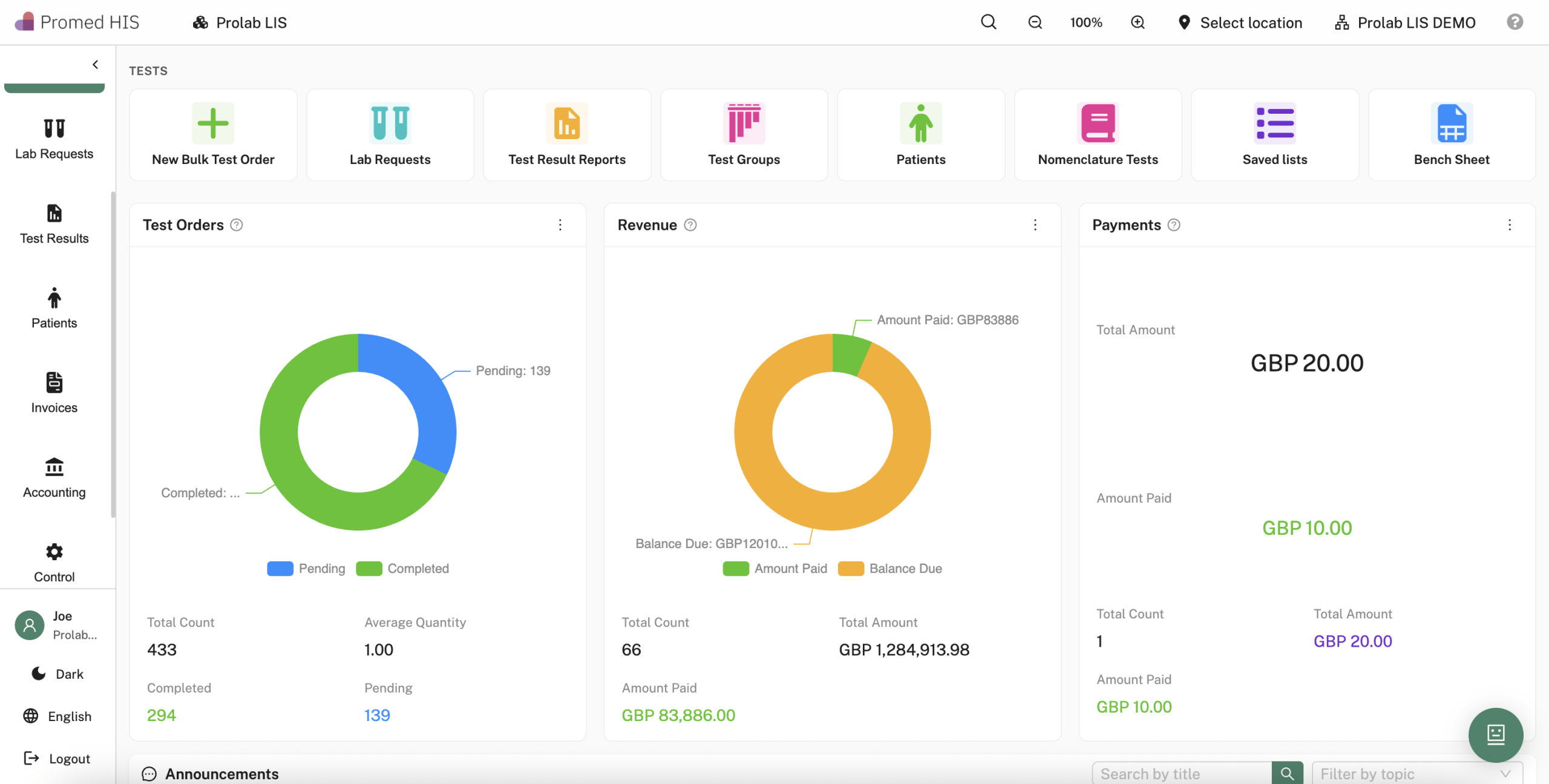
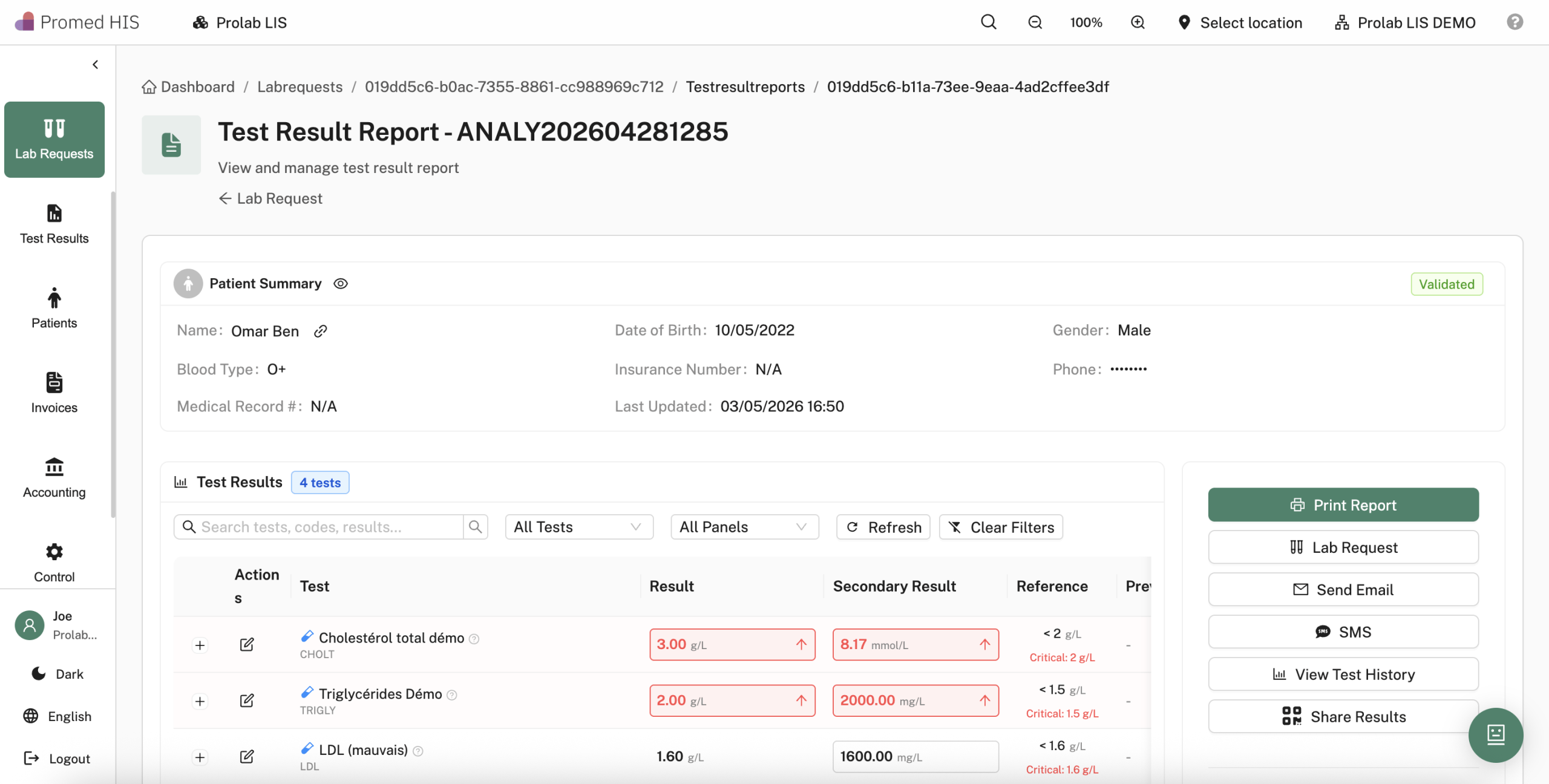
Prolab LIS — orders, traceability and LOINC-coded results
Prolab LIS is the laboratory information system inside Prolab LIS — not a bolt-on LIS with HL7 hope. Orders created during a consultation carry the same patient ID as the EHR; technicians work sample barcode traceability, QC, validation and digital sign-off before results appear on the chart.
Who it serves: lab managers, biomedical scientists, phlebotomy and referring clinicians. Critical path: order → sample → analyser/middleware → validation → PDF report → EHR timeline → portal/QR — with critical values pushed back to the responsible clinician.
- Multisite lab dashboard — workloads, pending validation, turnaround KPIs
- Barcode sample management — collection, routing, rejection reasons
- Instrument interfacing — middleware for analysers and external labs
- QC & validation rules — edits, comments, electronic signatures
- Structured reports — panels, reference ranges, longitudinal trends on the EHR
- LOINC-coded results — interoperability-ready result storage
Pharmacy management software
Pharmacy
Pharmacy — electronic prescribing and the medication circuit
The pharmacy module closes the medication loop from the EHR: electronic prescribing with dosage and duration, real-time interaction screening against 1M+ drug pairs, formulary alignment (CIEL, RxNorm), stock impact on Prolab LIS integrated ERP and Inventory Management, and dispensation traceability to the patient.
Who it serves: prescribers, clinical pharmacists, dispensary staff. Safety layer: severity-graded interactions with mechanism and review workflow before sign-off — ordonnance PDFs stored on the record without re-keying at dispense.
- E-prescribing — structured doses, routes, durations, renewals
- Interaction & allergy checks at point of prescribing
- Formulary & medical concepts — trust-wide preferred lines
- Inventory & expiry — linked to integrated ERP stock events
- Dispensing traceability — batch, lot, patient hand-off
- Billing sync — chargeable items flow to invoicing


Medical imaging software · RIS/PACS
RIS/PACS
RIS/PACS — DICOM studies on the EHR timeline
Integrated RIS/PACS keeps radiology inside the same health information management system as labs and meds. Referrers request imaging from the chart; radiology tracks worklists and acquisition status; readers report in an embedded DICOM viewer — X-ray, CT, MRI, ultrasound and mammography without a separate PACS session.
Who it serves: referrers, radiographers, radiologists, PACS admins. Patient access: portal and QR delivery of reports and key images alongside lab and pharmacy artefacts.
- Imaging requests — modality, priority, clinical indication from the EHR
- Worklist & scheduling — room, technologist, exam status
- DICOM viewer — windowing, series, measurements in workflow
- PACS storage — multisite, retention and access policies
- Radiology reports — structured text linked to the 360° view
- DICOM & interop — standards-based exchange where required


Clinical workflow
Visits
Visits & appointments — the active encounter layer
Visits are where clinical data is captured: chief complaint, vitals, examinations, diagnoses, care plans and orders. Appointments and queue management feed that encounter — in-person or via teleconsultation (Zoom, Google Meet, Microsoft Teams) on shared multisite calendars with SMS and email reminders.
Who it serves: front desk, nurses, clinicians, service-line managers. Downstream: completing a visit triggers lab orders, imaging requests, prescriptions and billable lines without duplicate entry.
- Structured visit workflow — intake → assessment → plan → orders
- Vitals & alerts — thresholds reflected on the patient summary
- Multi-practitioner scheduling — resources, locum, cross-site booking
- Queue & triage — waiting-room displays and priority logic
- Teleconsultation — embedded video, same record as face-to-face
- Queue-to-billing — visit status drives invoice readiness


Revenue & practice management
Billing
Billing — pricing tiers, invoices and receipts on the EHR
Billing inside Prolab LIS replaces spreadsheet tariffs and external accounting exports for day-to-day healthcare revenue. Configure pricing tiers and insurer-specific rates once; generate line-item invoices from completed visits with tax, payment terms and paid/unpaid status visible on the patient record.
Who it serves: finance, reception, contract managers. Accounting angle: complements practice management billing depth — native to clinical events, not a separate product.
- Pricing tiers — standard, discount, insurer (e.g. AXA) rates
- Rule engine — bulk refresh of tariffs across services
- Invoice reports — billing codes, quantity, tax, totals
- Receipts & print — invoice and receipt from one screen
- Balance tracking — paid, partial, unpaid at a glance
- Integrated ERP — stock-related charges and consumables


Healthcare stock management software
ERP
Prolab LIS integrated ERP and Inventory Management
Prolab LIS integrated ERP and Inventory Management covers pharmaceutical and consumable stock — reorder thresholds, batch and expiry traceability, supplier purchase orders and multisite warehouse visibility. Dispensing and clinical consumption events update levels in real time instead of month-end stock takes.
Who it serves: pharmacy stores, procurement, finance operations. Integration: prescription dispense reduces on-hand stock; billing can reference consumable lines tied to visits.
- Pharmacy & consumables — SKUs, locations, par levels
- Expiry & lot traceability — FEFO-friendly workflows
- Supplier & PO management — approvals and receiving
- Multisite console — transfer and network-wide alerts
- Alerts — minimum stock and near-expiry notifications


Clinical AI healthcare
RAUTOR — AI agent inside the EHR
RAUTOR is clinical AI embedded in Promed EHR — not a sidecar chatbot. It fetches patient context, drafts operational and clinical reports, and analyses lab trends to support review. It does not diagnose, prescribe or replace clinician judgement (AIaMD positioning: assistive under human control).
Who it serves: clinicians and medical leadership evaluating safe AI in workflow. Data boundary: reads the same EHR timeline; does not create a parallel patient store.
- On-demand patient context from the record
- Report drafting from platform data
- Lab trend analysis for clinician review
- Zero extra login — launched from the chart
- Never autonomous clinical decisions
Inpatient & patient flow
Bed management & queue displays
Hospital operators get ward-level visibility without another vendor: real-time bed maps, admission/transfer/discharge tied to the EHR admission, plus queue screens and triage logic synced with appointments and registration.


Ward clerks updating bed status in a whiteboard while outpatients wait on a paper ticket — the two flows never meet, and finance learns about a discharge when billing chases the ward days later.
Prolab LIS links inpatient bed maps and ADT to the same admission on Promed EHR, while queue management and public displays pull priority and estimated wait from appointments and registration — front desk, nursing and finance read one patient flow.
- Bed map — occupancy, patient assignment, length of stay
- ADT workflows — admit, transfer, discharge with billing hooks
- Queue management — public displays, estimated waits, priority rules
- Multisite inpatient — network capacity from one console
Next step
Pick modules for your facility
Clinics often deploy EHR, visits and billing first; hospitals add LIS, RIS/PACS, inpatient and ERP on the same tenant. Child module pages add compliance and deployment detail per area.